
 |
 |
 |
 |
 |
 |
 |
 |
 |
 |
 |
 |
 |
 |
 |

The Outset is - the ease of simplicity. The unexpected of the understated. We believe that skin is best when you begin with the basics. Products that have purpose - to do more with less. Embrace the elemental and find freedom in the uncomplicated.
The Outset is where you begin again
→ theoutset.com ←
→ sephora.com ←
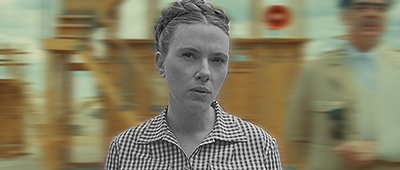


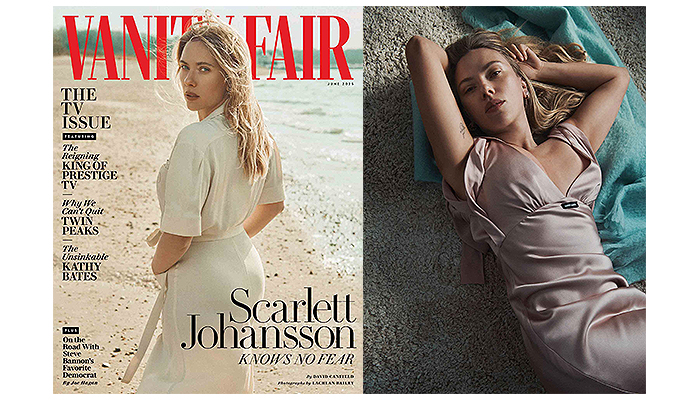
The Season of Scarlett Johansson: Two Hot Films, Her Marvel Future, Woody Allen and a Pick for President
Rebecca Keegan
September 4, 2019

With Noah Baumbach’s ‘Marriage Story’ and Taika Waititi’s ‘Jojo Rabbit,’ her ‘Avengers’ spinoff ‘Black Widow’ and the mantle of the world’s highest-grossing actress, Johansson isn’t afraid to say how she really feels about Disney and her plans to direct.
When Scarlett Johansson met writer-director Noah Baumbach for lunch in 2016 to talk about a role, she was in the midst of a private ordeal, divorcing her second husband, Frenchman Romain Dauriac. Baumbach, who didn’t know about Johansson’s pending split, was eager to discuss an unusually exposing film he was writing. The tragicomic story would explore terrain Baumbach encountered as a child of divorce, while ending his marriage to Jennifer Jason Leigh and via stories from friends, judges, lawyers and mediators — the hideous fights, the mercenary lawyers, the wistful moments of wondering whether things could be different.
Before Baumbach launched into his pitch about why he thought Johansson would be perfect for the role opposite Adam Driver, the actress shared what was going on in her marriage. “It totally caught me off guard,” Baumbach says. “I was like, ‘Well, you’re going to either hate this idea or love it. This may be exactly not the headspace you want to be putting yourself in, or maybe it will be healing.’ ” The movie, Marriage Story, turned out to be the latter. “We talked a lot about the actual experience of divorce because I was in the middle of the process,” Johansson says. “We talked about becoming a parent, and our parents. The expectation that comes with being in any kind of a relationship, and the disappointment that can come with that expectation.”
Johansson, 34, is recounting this story in early August on the set of Marvel’s Black Widow outside London, where she has been living with Rose, her 5-year-old daughter with Dauriac, for five months. Fresh from a morning of fight training, she arrives for an interview in a wood-paneled conference room at Pinewood Studios wearing an Avengers T-shirt, her hair in a messy bun, a gold chain with Rose’s name on her throat. It’s a hectic time for the actress: This fall, Johansson, who has never been nominated for an Oscar despite critically acclaimed performances in such movies as Lost in Translation and Match Point, stars in two likely awards contenders, Marriage Story for Netflix and Taika Waititi’s Jojo Rabbit, for Fox Searchlight, both screening at the Toronto Film Festival. When Black Widow opens in May, it will be the first female-fronted extravaganza to kick off the summer box office season. She also is preparing to send Rose to kindergarten in New York City and wed her fiance, Saturday Night Live’s Colin Jost.
In person, the actress is unguarded and assured, even on thorny topics — from actors playing characters of different races (which sparked a fierce debate) to whom she’s backing for president to why she’s standing by Woody Allen. She apologizes that her answer to one question sounds “farty” (pretentious) but never asks for forgiveness for her opinions.
“How do I feel about Woody Allen?” Johansson lets the question hang for a moment. Ever since the #MeToo movement caused Dylan Farrow’s sexual abuse allegations against her father to be re-examined, much of Hollywood has distanced itself from Allen. The filmmaker long has denied the claims, but many actors who have worked with him, including Michael Caine, Timothée Chalamet and Greta Gerwig, have publicly expressed regret about doing so, and Allen has been unable to find a U.S. distributor for his movies since Amazon canceled his deal in 2018. Allen directed Johansson in Match Point (2005), Scoop (2006) and Vicky Cristina Barcelona (2008) and played a key role in shaping her career as one of Hollywood’s most sought-after leading ladies. After a beat, Johansson makes it clear that she disagrees with many of her peers. “I love Woody,” she says. “I believe him, and I would work with him anytime.”
Johansson continues: “I see Woody whenever I can, and I have had a lot of conversations with him about it. I have been very direct with him, and he’s very direct with me. He maintains his innocence, and I believe him.” Asked if this position feels fraught to express in a cultural environment where there is a new and powerful emphasis on believing women’s allegations, Johansson says, “It’s hard because it’s a time where people are very fired up, and understandably. Things needed to be stirred up, and so people have a lot of passion and a lot of strong feelings and are angry, and rightfully so. It’s an intense time.”
Johansson is active in women’s issues — at the 2018 Women’s March on Washington, she delivered a passionate speech about the importance of Planned Parenthood and women’s health and called out James Franco, who had worn a Time’s Up pin to the Golden Globes days before the Los Angeles Times ran a story with five women accusing him of sexual misconduct. (Franco denied the allegations.) “How could a person publicly stand by an organization that helps to provide support for victims of sexual assault while privately preying on people who have no power?” she said in the speech. “I want my pin back, by the way.”
Johansson got involved with Time’s Up in the early days of the organization after Natalie Portman emailed her about it and was one of the original signers of the Time’s Up announcement letter and donors to the Time’s Up legal defense fund. “It was almost like you found something you didn’t even realize you needed,” Johansson says of the conversations she began having with her female colleagues. “It was when I first understood what the word ‘triggering’ actually meant. Now it’s part of the zeitgeist, but it was like, ‘Oh. Oh, the thing I’m feeling. That’s what triggering means.’ I didn’t know. Suddenly, you didn’t have to take it anymore.”
***
In Jojo Rabbit, Johansson plays Rosie, a single mother in Nazi Germany who is hiding a Jewish girl in her home. Rosie is the moral compass of the politically provocative satire, in which Waititi portrays an idiotic (and imaginary) Hitler for laughs and Sam Rockwell and Rebel Wilson are especially incompetent Nazis. “She’s such a warm, comfy character,” Johansson says of Rosie. “I wanted her to feel playful and just be a really creative, positive person who was in the middle of her life, who had joie de vivre … so you miss her when she’s not there.” Waititi says he modeled Johansson’s character, a single mother, on his own mom and other independent-minded women like her raising children on their own in the neighborhood where he grew up in Wellington, New Zealand. Though Johansson is the rare sane character in the comedy, she still is there to land laughs, a task at which Waititi feels she has been underutilized. “She’s so funny; I was always amazed people had not really tapped into that,” Waititi says. “If you get to know her, it feels really obvious that she should be doing more comedy.”
Shortly after Disney’s planned acquisition of most of 21st Century Fox was announced, Johansson was at a dinner for Disney board members with some of her Avengers castmates and Disney executives. “The Disney execs were saying, ‘We’re excited about Jojo.’ They had just acquired it,” she says. “I said, ‘How is that going to be?’ Because Searchlight’s made quite a lot of subversive films. It’s harder and harder to try to find a home for something that’s more off-color or subversive and push the limit. I thought, ‘There’s no way Disney would bring [Jojo Rabbit] out. … This doesn’t belong to that [Disney] family.’ ” Johansson’s tablemates reassured her, she says, pointing out, “Whether it’s Pixar or Marvel, the most important thing is when Disney acquires a company that’s working, they let the studio continue to have their own style. The creative freedom of that studio stays, the DNA of the studio stays intact. Ultimately when Jojo Rabbit went over [to Disney], it didn’t make any difference, which was cool. Because I was worried that maybe it would.” In fact, Disney is so bullish on Jojo Rabbit that CEO Bob Iger will host a private screening of the film as part of its Oscar campaign in a show of his support for Fox Searchlight.
After making eight Marvel movies, and with another on the way, Johansson knows the world of Disney as well as any actor. She’s getting a closer look at it on Black Widow, the first Marvel film she’s executive producing, providing input on script, director and casting decisions. Of holding down the summer opening slot usually reserved for male-fronted films, Johansson says: “The movie packs a big punch. If that slot is reserved for movies that pack a big punch, then we’re in a good, good space.” She also has parity with her male counterparts when it comes to pay. Johansson will earn more than $15 million for Black Widow, similar to Chris Evans’ and Chris Hemsworth’s rates for playing Captain America and Thor, respectively. “Money is a taboo topic of conversation,” she says, when asked about her salary. “But I will say that, yes, I’m on an equal playing field with my male cohorts.”
One of the most emotional scenes in Avengers: Endgame for Marvel fans arrives — spoiler alert! — when Johansson’s character leaps to her death to save the world and prevent Jeremy Renner’s Hawkeye, Black Widow’s perennial will-they-or-won’t-they friend-with-chemistry, from doing so himself. Johansson first learned Black Widow would die in Endgame when Marvel Studios president Kevin Feige called her to break the news as they were about to start production on Avengers: Infinity War. “The finality of it was sad, but I was excited to die with honor,” she says of the scene. “It felt in-character that she would sacrifice herself, of course for humanity but actually for her friends, for the people she loves. It was bittersweet.”
Black Widow, which is directed by Cate Shortland (Lore), is a prequel to Endgame, catching up with Johansson’s character, Natasha Romanoff, after the events of Captain America: Civil War. Executive producing the film “is liberating in a way,” Johansson says. “I feel like I’m in control of the destiny of this film, which gives me a lot more peace of mind,” she continues. “I know her better than anybody. What was her childhood like? What is her relationship to figures of authority? This character is gritty and multi-dimensional but has a lot of trauma and has led an unexamined life. In order to operate at this elite level, she has probably had to push away a lot of stuff.”
The actress says she doesn’t know what projects she’ll tackle after Black Widow but has an eye toward moving behind the camera. “Before, I was more focused on my acting career,” she says. “Now, I’d happily take the time to develop something to direct. I’ve actively looked for a long time and just haven’t found the right fit.”
The Outset is - the ease of simplicity. The unexpected of the understated. We believe that skin is best when you begin with the basics. Products that have purpose - to do more with less. Embrace the elemental and find freedom in the uncomplicated.
The Outset is where you begin again
→ theoutset.com ←
→ sephora.com ←